Friday, March 30, 2012

Preposterous Writing


Ted: The Geek of Wrath

     The virus worked perfectly. The fires in the cities quickly spread to the suburbs, then to the countryside as the remaining few fled in terror. Radio and television stations were off the air, cable networks and satellite communications were dead. Phones didn't even get dial tones anymore.
     Harvey was finally alone. His decades of secretive work, clandestine meetings, self-education and sacrifice had finally paid off. He was the last human being on planet Earth.
     He contemplated his blissful solitude while looking over his garden. Plants never needed to be impressed, never judged, and never laughed at you behind your back.

     There you go. All you see above is all I know about the text and author (Ted). And that it's written on September 27th 2006. Not that it matters. It comes from a site whose members are prompter to write 100 word stories weakly. The occasion for writing this is the following prompt: "In honor of our internet service being down...AGAIN... please write something today regarding being completely cut off from civilization."
 
   
We need to inspect! 
Get your goggles!


     The preceding passage has the impeccable potency to diabolically mesmerize the reader with its heinous essence and intimidating portrayal of the human revengeful disposition.
     Nah, just kidding. I can't stand to read, let alone write in such ludicrous manner. I bet half of my words were used improperly.

     Getting serious now:
     Blah blah blah. revengeful disposition. Concurrently, the childishly simplistic delineation of the extirpated and perturbed locality is only an adumbration of the slovenly aftermath of such a pernicious venture as executed by the solitary character.

    *giggle, giggle* I did it again.
    Took me a bunch of thesaurus searches to convert my mediocre writing into such.. such... whatever!
   
    So, what's the main point of this?
    Did you like the writing? NO!
    Did I like the writing? NO!
    Did you think any more of me for being so "classy"? NO!
    Should I expect accolades for those sentences? NO! 

    Would you understand it better if I wrote: 
    "The text above has the power to devilishly amaze the reader with its evil nature and the scary picture it makes of the human revengeful nature. At the same time, the concise description of the chaotic environment symbolizes the messy consequences of the acts of the main character."
   
    Or would you prefer:
   "This text is amazing! It shows how evil a man can be. Also, it shows how much damage a man can do!"

I hope I managed to "show" (not "disclose") the different "degrees" (not "gauge") of "preposterous" (yes, I have to use that word here, it's my new favorite) writing.




Thursday, March 22, 2012

Text Analysis at Its Best

     How elaborate can an analysis be if it regards a very short text, that isn't an excerpt that can be connected with other works, whose author we don't know, that has only one character, doesn't directly address any polemics or issues and is simply an "L'art pour l'art" piece?
     I'm guessing it can be huge. A critic, an English teacher (hehehe) or just a reader over-thinking everything can pull out a whole cornucopia of hidden meanings, allusions, metaphors etc. He/she can infer the physical and mental state of the writer, connect this to sociological issues, to Marxism or feminism, to mythology or religion.      Maybe someone was drunk or high or bored and scribbled the first thing that came onto his mind, but if you ask a critic, it can be a perfect reflection of his childhood traumas and related to the political events in the environment the writer grew up in.
     And then, I'm asked to analyze something for my weekly journal! Can half a page of SOAPSTONE based writing really tell enough? And if not, can I really hope to dissect a text in such tiny and precise iotas with arguments that make sense? Probably not.
     Then why try? For a grade? For fun? For that tiny piece of hope that my words can actually be perceived as something of great importance, of value, something that took time, intelligence and intellect to compose?
     I don't know!
     But I guess, if analysis can seem so absurd and preposterous, yet artistic and thoughfull, then whatever gibber I make up has the chance of being seen as refined. And then maybe even my text will be left in the hands, no, claws, of another mind that tries to find meanings, draw connections and formulate theories out of nothing.
Good luck to me, then. We'll see how that will work out.

Wednesday, March 14, 2012

Obsessed With Bacon

   I must say, I have o special affinity towards bacon. Maybe that was the reason why this text seemed so stupid and ridiculous.
   Here's a link: Bacon Stockings.
     As a society, we’re obsessed with bacon.
     If it isn’t bacon-flavored, it looks like bacon.
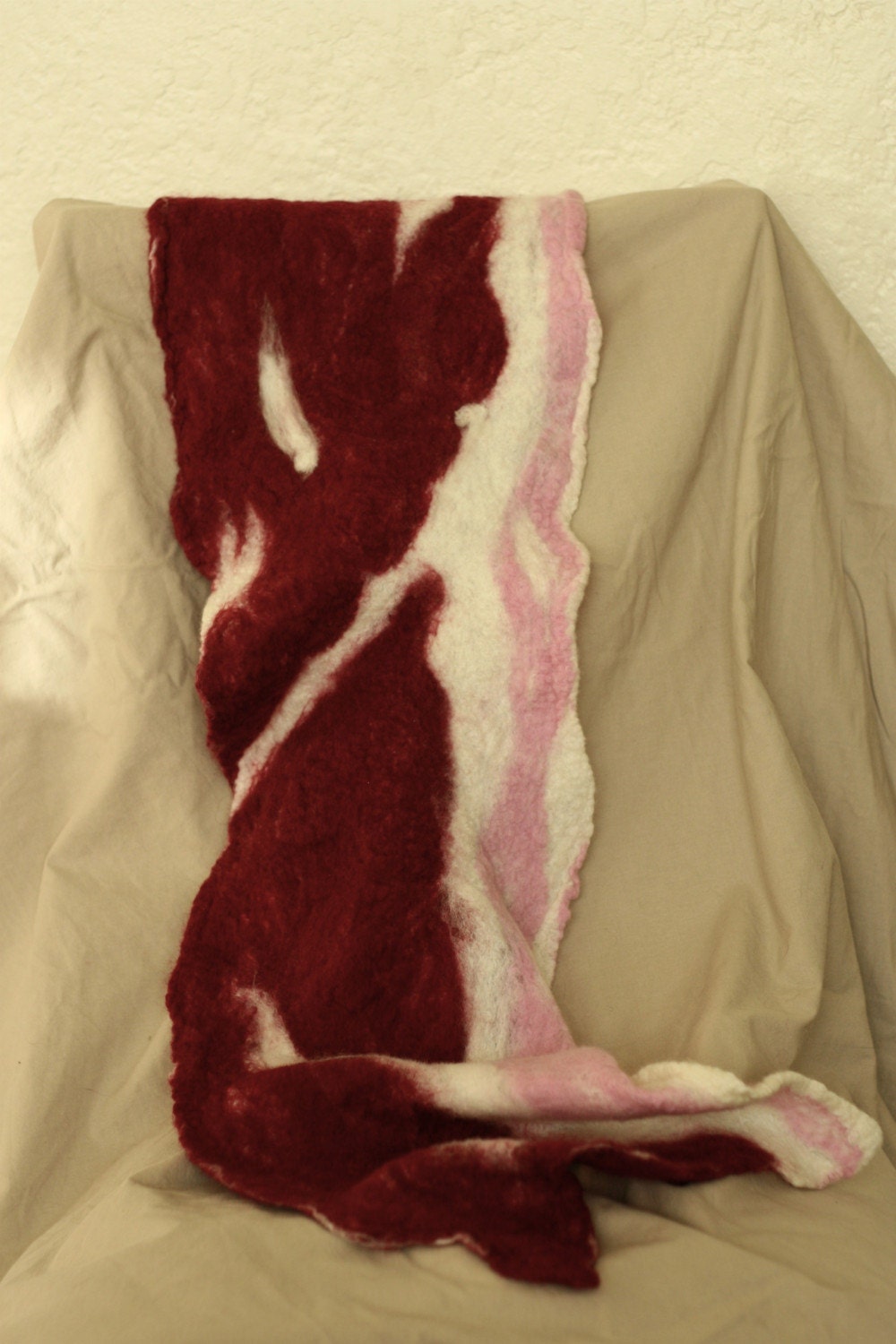
     I’ve seen a bacon-patterned knit scarf. It’s like wrapping a slice of bacon around your neck.
     And I know a fashion designer who is making photograph-sourced bacon stockings.
     They have the all striations and [marbleization] of natural bacon, very lifelike.
     And very creepy.
     But, if you think about it, it’s a lot more sanitary than using real bacon on your legs.
     Sure, the grease will help them stick, but once a stray dog catches the scent, you’re going to get chased all the way home.
   First of all: who is he to say that the whole society is obsessed with it? Maybe he is, but he shouldn't generalize. Plus, there are many things that neither taste nor look like bacon. It's a good thing that the author doesn't specify what is or isn't. It leaves space for the reader to interpret the statement and set his/her own perception of things and their extent of relatedness to bacon.

   A little about the text itself.
  • His sentences are simple. 
  • He appears amazed. 
  • The tone is very informal, as if he's talking to a friend. 
  • It might seem as if he appeals to ethos, since he uses "we" when speaking of the society, indicating that he's a part of it.
  • Occasion? - he was probably hungry for bacon, or just had some!


   Now "enjoy"! Here's what he means by bacon-patterned scarf: 


Stockings, however, I couldn't find.

Thursday, March 08, 2012

Sentence Types

   The text I'm going to look at this time is a 100 word story, whose author I can not name, since he goes only by the username "-ls/cm" on this site: http://podcasting.isfullofcrap.com
   You can find the story here.
   I will also paste the text here for easier referencing:


   I have a lot of chores to do every day.(1)
   There was an app for To Do lists on my phone, but I’d have to stop playing Angry Birds long enough to check it.(2)
   So, I picked up a cork-board and pinned my to do list up there.(3)
   When I finish a task, I stick in a pin.(4)
   I call it my Voodoo To Do List.(5)
   I just have to be careful about putting names on it.(6)
   Like when I wrote “Get birthday present for Stan” and stuck a pin in it.(7)
   Poor Stan.(8)
   Hold on.(9) Gotta add “Stan’s Funeral.”(10)

   It can be seen that the style is rather simple, the sentences concise and clear. But, what kind of sentences are there really? Here are a few definitions: 

Simple sentence: A sentence with one independent clause and no dependent clauses.

  • sentence (1) - subject: I, verb: have
  • sentence (5) - subject: I, verb: call
  • sentence (6) - subject: I, verb: have to
  • sentence (9) - command sentence, subject: you (assumed), verb: hold on
  • sentence (10) - colloquial, subject: I, verb: have got to


Compound Sentence: A sentence with multiple independent clauses but no dependent clauses.

(The coordinators that join them are as follows: for, and, nor, but, or, yet, so.)

  • sentence (2) - independent clause 1, but independent clause 2.
  • sentence (3) - independent clause 1 and independent clause 2 .


Complex Sentence: A sentence with one independent clause and at least one dependent clause.

(  A complex sentence always has a subordinator such as because, since, after, although, or when or a relative pronoun such as that, who, or which. )

  • sentence (4) - when dependent clause, independent clause.


Complex-Compound Sentence: A sentence with multiple independent clauses and at least one dependent clause.

  • no examples in the text above


Sentence Fragment: An incomplete sentence, usually a phrase or a clause mistaken for a sentence.

  • sentence (7) - It may seem understandable, but there is no complete meaning
  • sentence (8) - It is kind of an exclamation, could be confused with exclamatory sentence.

Wednesday, February 15, 2012

Analogy


To quote some Joe from Tweeter – the guy is actually named Joe, this wasn't a reference to “a random person” – “Finding the perfect analogy is like balancing a muffin on a pencil”. It’s wonderful how the phrase is so clear, yet ambiguous. Is it as difficult to perform such a maneuver? Or can you just stick the pencil’s ending into the dough and have the muffin static in the blink of an eye? There’s no way to know unless we ask him, but then again, who guarantees he has considered both options?
So, regardless of the level of difficulty of finding a fitting analogy, what is it really that analogy stands for? It has been defined as “a work that functions on a symbolic level, a kind of extended symbolism.” However, for the well trained eye, everything can have multiple meanings and some alternative representation, even if the author himself doesn’t know it or see it.
Analogy can often be mixed with metaphor and extended metaphor, since they are pretty similar, varying only in their extent or elaboration, the use (or lack thereof) comparison conjunctions, or the directness with which they are stated and acknowledged.  It’s all about comparison, comparison, comparison!
Finding examples of analogy is like going shopping for “something new”. You don’t know what you are looking for, but when you see it you know it is the real deal.
OK, maybe the previous wasn’t that successful, but after all, they are simply for clarifying or embellishment. Look for any comparison in anything you read, and unless it is absolutely literal it’s either a metaphor or an analogy.

Next, we observe newspaper articles (not op-eds!) and how and what they use to fit their purpose.

Wednesday, February 08, 2012

   Nobody likes complaining, right?
   Well, I'll do it anyways:
   A couple of days ago I finished reading the trilogy titled "The Hunger Games" by Susanne Collins, and I warmly suggest it to everyone. The problem with this is that there's an upcoming movie filled with new teen hot actors that are about to drive the audience crazy and create another insanity as the case was with other teen blockbusters before. Still not seeing the bad thing?
   When "twilight", the books came out, they were regular chick flick-like books. the movie made everybody think its the lamest awfullest thing in the world. 'The Last Song" By Nickolas Sparks is a touching book that can reach out to everybody, make you laugh and cry with the characters and most importantly, not let you close the book until the very end. However, the movie, "starring" Miley, the "teen diva" and Liam Hemsworth, the new "blond cutie" made everyone thing it was another work of pink lit, automatically making it repulsive to everyone who has not read, but was maybe going to read the book.
To say that their reputations got ruined would be an understatement. 
   So, consequently, the Hunger Games Movie, is probably going to be another douche-bag movie with stuff that deteriorates from the actual plot, with many dull scenes and with dialog that the "audience wants to hear". Stop it you Hollywood annoyances, ruining literature for fame craze and money.
   Oh, the device of the week?
  One should make up a name for this desecration, PuRuBo ByMaThMoVe
Publicly Ruining Movies By making Their Movie Versions!


STOP IT!

No Really...


STOP IT!!!

Friday, February 03, 2012

The Antipode

   Well, I'm glad this happened, cause I was really running out of things to talk about. I am no longer limited to exposing hyperbole, but I can use other rhetorical devices, or I can even comment on op-eds, maybe combine both and see the devices in op-eds!
   Now that I can write about such a wide range of things, I found myself wondering what should I start with. Just so that I clear this thing with overstatements out, I think that I should shine a light on the so different on the outside, yet so amazingly similar in the purpose: understatement.
 We use this to present something demeaning its extent or value, but making it so obvious that the reader understands the actual magnitude of the subject discussed.
  The example used in my class when explaining this was: "Bill Gates has a bit of money!"
  This is like saying: "There are a couple of people who know 'bout Brangelina!".
  Putting it in context, on a stormy day a person can state "It's just some rain, out there." or on a scorching day use "Mildly warm"!
  Now that we got the basics we can later dwell on more complicated or subtler uses of this device.

Friday, January 20, 2012

So much to study

I'll simply present few graphs that would hopefully depict my point. This time, the guilty ones of committing exaggeration are students!

Now, I have an ENORMOUS headache, I have TONS to study for the exams, and I'm really sick (and this is no exaggeration).
The only problem is, I never found out where the line between the actual pile of work, and the metaphorical one lies!
Off I go to drink that HANDFUL of pills!

Tuesday, December 27, 2011

New Year's Eve

    My first thoughts about December's only entry was: New Year's Eeeeeeve!!! A lot of people might say: Christmaaaass! But I celebrate it on the 7th of January, like all Orthodox Christians. 
    Well, everybody exaggerates about New Year's Eve. The whole "holiday" has turned into a giant parade, where people dress up, get drunk, buy stuff and "go wild" just because it's "New Year's Eve" and well, because society says that in this occasion, all the luxury is allowed.
    So, I must admit, I did ask Google for "Christmas exaggeration" and "New Year superlatives", just to see how others have shown their opinion on this subject. I stumbled upon a text written by some girl, describing her "most drunk", "most otherwise intoxicated", "saddest" and "most embarrassing" New Year's Eves.
   Vera, the author, ends her piece of writing with "Will tonight be another superlative? God, I hope not."
   So why does the world care so much about that one night? No offense to the author, but, there must have been other nights when she was drunker, higher, sadder or more embarrassed. I don't see her mentioning them... Why are the experiences from such a night so important and notable?

   My guess is that some people just want to abuse the opportunity given to them, when they are allowed to be "excessive" and when it takes extremes just to blend in. 
   For some others it might be a night when stuff changes. Yay, new calendar! As if it is a big deal! 
    They might hope for happier this, better that, more of those, improvement in these in the new *insert number here* year. 
   New Year Resolutions? Is there anyone who has held on to them, truly? Such are few, if any.

   Lastly, (yup, the transition makes this sound like a five paragraph essay) there are those who really don't care about the occasion, but society imposes this artificial fever on them, so they are expected to "gather up with friends", "turn the music up", "kill the booze" or whatever, and unwilling to be seen as freaks they just succumb, put on a fancier shirt or skirt, go out, (or in, wherever the celebration is) and pretend it's not just an ordinary party, on an ordinary Friday, with ordinary people, ordinary food, few extra drinks or an occasional first-time-drunk-cos-it's-cool, who has spent the few hours of the New Year in the bathroom, spilling his/her guts out.

   The aforementioned text was written on 31 Dec 2003, about 8 years ago. I didn't notice this at first. The text seemed as if it could've been written this same day. Some stuff doesn't change, I guess.
   Maybe people do need such a thing, just to let all that extra energy out (if they have it, which is debatable). The concept of New Year may succeed at convincing people to be cheerful, that better times are coming, that they'll get a better job or their crush will start liking them back. It is a time when people are not only allowed to, but encouraged to exaggerate. Otherwise, reality might finally manage to beat us up.

Friday, November 25, 2011

2 in 1 - What Not To Do: Hyperbole in Arguments

    I am not a huge fan of poetry, but it happens now and then that I actually take a minute to read a few verses. This one just randomly popped on my monitor on a home-page of a free e-books site. The only reason why it caught my attention is the first verse through which I completely identified with the author, a certain Carl F Maulbeck. "For the time being I'm doing nothing."
   There I was (only minutes ago, but now I'm doing homework, so "now" doesn't count ), at almost 2am, clicking and typing pointlessly in pursuit of entertainment. Metaphorically, and well, practically, I was doing nothing. Technically, I was breathing, watching, reading, clicking and so on and so forth. But, it's poetry, right? So exaggeration is not only fine, but sometimes key!
   Verse 2: "And I will never be the same" - is this exaggeration? Big words such as "never" and "always" are usually signs of exaggeration; and of weak arguments, of course, though that's out of the topic. However, this is one of the rare cases where "never" fits perfectly. Since we change with every millisecond that passes, out current state of body and mind can not be repeated in its entirety. So, no exaggeration here.
   Verse 3: I can barely move (emphasis added). Now that's how one makes their case believable and not easily crushed. I can say he moves, writing this poem. Otherwise the tense would be wrong. Or maybe he was just thinking about it! But then there would be signals rushing through his brain, so there is some movement. If he used "I can't move." I would most definitely say: "Ha! Or can you?" But he used "I can barely move", so he's safe! What a useful word "barely" is!
   Verse 5: "There is no remedy for how I feel" - Are you sure? Is there none or have you just not found it yet? Has it simply not been discovered?
   Further in the poem there are some philosophical points, some abstract ideas and what not. But, it's poetry, so it's kind of meant to be the complete opposite of down to Earth. The guy's a poet, thus.. no hard feelings. Blame this on my argument beating attempts I've unconsciously been practicing in every aspect of being in the past few days. Pardon my stray of focus off hyperbole. But then again, everything is connected, isn't it? If he used hyperbole, then his claim would have been easily destroyed. Isn't that absolutely true?

  Now go back and check the italicized stuff, both the green and the red colored words.What's easier to disprove? :)

  I almost forgot:
  Maulbeck, Carl F. Lost and Found?. Scribd. Web. 24 Nov. 2011. <http://www.scribd.com/doc/36820325/Lost-and-Found>.
 Except that I have no clue how to add the hanging indent in a blog post!
 Oh, and maybe I should change the title to 3 in 1...

Thursday, November 24, 2011

Hyperbole in Advertising

     Few days ago we were given an assignment that involved finding ads, identifying their claims, support, warrants etc, so that we get more insight into how argumentation works.
     So, I figured I should finally provide an example of hyperbole in advertising, the existence of which I have claimed since I started this blog, but never really proved.
      Here's a picture:
     No, The high heels are most definitely that high, to make the girl wearing them have her head in the clouds. Well, my previous statement is true as far as we are referring to the term's literally, not in its idiomatic meaning. As a matter of fact, a girl with fancy shoes is highly expected to have her head in the clouds.

   Another example can be this picture:
    It implies that the binoculars are so good, that the lifeguard can monitor all that is happening on the beach even from the desert. We don't exactly know how is he going to get there in time to save somebody when needed, but the advertisement sure makes its point.

   And finally:
    This vacuum cleaner is so powerful, it took an air balloon down.


I believe my work here is done :)

Tuesday, November 15, 2011

The Future Big Bang of Truth

 The Big Bang Theory is a TV show I watch somewhat regularly. I used those words to describe the frequency because due to the amount of work I have throughout the working days of the week and the availability of the show solely online, I simply download few episodes at a time (when I find some) and watch them here and there during lunch or dinner.

I have noticed a long time ago that at the end of each episode there is a small font text on a white background, and every time I ignored it as a part of the credits or data regarding the episode.
It wasn’t until recently that I accidentally paused instead of closing the window, and was surprised to notice that the text wasn’t plain data. Apparently, the producer makes half page comments on issues unrelated to the episode, but rather on religious beliefs and science, social dilemmas and abstract questions, hot topics and esoteric concepts.
Intrigued and amused, I started looking for many of the video files, rushing to the end of each to read the entry. Here’s one that I found particularly interesting, especially after reading Jacques Ellul’s “Is It a Dream or a Nightmare” in AP Lang class.
In the near future, we will see brain scan technology that can determine, without fail, if someone is telling the truth. Shortly thereafter, we will be able to buy mobile devices that perform the same task on the fly. In other words, we are on the verge of having all of our conversations constantly and instantly monitored for veracity. This would then spawn a counter-technology comprised of personal mind shields that keep one from being scanned (the use of which would, of course, imply that one is keeping secrets). The end result? Universal honesty, initially as a result of the duress of surveillance, will become the norm. Then, over time, this mode of thinking, communicating and behaving will become second nature. This will usher in the dawn of a new civilization. After thousands of years of human suffering, world peace and the long-fabled “good will towards all men” will have finally arrived. The end of lying and cheating will also mark the end of scripted entertainment. So, you know, there will be a downside. (Chuck Lorre Productions #326)

This passage is obviously making the statements sound definite, as if they are inevitable and are going to happen for sure. Since this is all the product of somebody’s imagination, No certainty can be expressed when considering the issue. Chuck Lorre is simply stating hypothesis or predictions here. However, the style with which he has written this not only adds to the way in which the reader perceives the premise, but it presents it in a matter-of-fact way which puts it as taken for granted and not to be questioned. If one was to name the actual technique the author uses, one wouldn’t be wrong to declare exaggeration guilty of charge.
As a short clarification, the hyperbole is seen because the writer takes the small possibility and blows it out of proportion, trying to persuade the reader of the likeliness of the events described to occur. With little sureness can one say either that such apparatus will be invented, or that it will influence and shape society in such a manner. The conversion of the habit of being truthful into second nature is overstated, and so is the generalization regarding the new civilization and the world peace.
Overall, the impression the passage leaves is due to the use of hyperbole and overstatement, the determination and confidence with which the author states his theories and the level of straightforwardness and doubtlessness of the text itself.


Wednesday, November 02, 2011

Pants On Fire, or Maybe an Apartment

     1 Nov 2011
     While I was getting ready for school this morning, an hour later than I usually do, thanks to today's lack of first class, an unusual clamor stopped the complete silence. Strange scraping could be heard from somewhere in the bathroom, from a pipe inside the wall I couldn't identify, and the weird intermittent sound was too loud to be simply the water going through the heating system.
     I have rarely been home and awake at that time of day. During workdays I am at school then, and I am sleeping during weekends. For a second I thought it was some kind of a refill, some regular normal procedure going on in the old heating installation. The hoarse "melody" continued for a while. After checking that everything is fine in the bathroom, i.e. there's no wall leakage or broken pipe, the water is running smoothly and the water boiler is off, I just acquiesced that the situation is such, I made sure all electric stuff is off, opened the door, walked out of the empty apartment, locked from the outside, and started climbing down the stairs.
     Revelation was supplied on the third floor, where the radiator had apparently started not only leaking, but literally shooting out gallons of hot steaming water. The hall was flooded, the water was running down the other floors, making the old lady's apartment on the second floor, (right beneath the one where the accident happened) a giant mess. To add up to this, the neighbor was helplessly banging on the door where the leaking initiated, trying to call on the owners who were either absent or asleep. Yet, when I think about it, they couldn't have been asleep, the noise was too loud, was supported by banging, and many people were out on their thresholds in their pajamas, all trying to get the water out of their doors, and prevent more from coming in.
     "Hey girl, do you have these people's phone number?"-the man who was banging on the door said.
     "No, I'm sorry. What happened?" - I asked, pausing, even though I had to hurry, and I was already aware of the answer.
     "Heating system is leaking from their apartment. A vent was broken or something."
I noticed the water dripping in the middle of the stairs, and the tiny lake that was formed around where it was splashing. Vapor was emerging. It was definitely hot!."Can one pass?" -I asked.
     "Of course! That's no big deal!" I started walking as close to the wall and as far from the water as I could, the second I heard the slightest reassurance that it will "not be a big deal".
     "Thing is, if we don't get in there to stop that, this whole building can burst in flames." His voice reached me though I was a floor and a half down.
     I stopped for a second.
     Was he exaggerating? - I thought. Can it get so hot for the wood and cement to just light up?
     I couldn't tell.
     The basic stuff I needed the most was with me. I was off to school. I was in no danger. The apartment's not mine, and I have little stuff of big material value in there. I could do nothing at the time, and I wasn't intending to go back and pass around the steaming waterfalls to get the laptop or something just because I was slightly paranoid.
     I left the building with that question stuck in my head. It kept me thinking for a while.
     Weird scenarios appeared in my mind for the whole duration of my walk to school.
     Having the lucky coincidence of AP Chemistry being my first class. I consulted with my professor about temperatures and spontaneous combustion. In few minutes, I was completely reassured that the building was in no danger of fire.
     But if I didn't, that question would've - no doubt - haunted me all day.
     The thing I wonder now is: Did that man know he was exaggerating, was he doing it on purpose, to sort of show me how big of a deal the leakage was? Or was he simply panicking and not thinking too much about the conditions and the possibility of the outcome he presented.
     And thanks to this, I see that sometimes exaggeration can have a whole wider impact than just overstating something for the sake of it.
     Sometimes we can't control it.
     Sometimes it seems right to put something in such manner.
     Sometimes we don't even believe it's an exaggeration.
     After all, with us being persuaded that "everything is possible" by motivation books, advertisements, billboards, professors and advisers, can we really tell when we've taken things too far?
     When I returned home, I was happy to find out that nothing happened, all was settled, the water was pumped out.
     All went well.
     But thanks to that guy who was slamming his fists at the neighbors' door, trying to figure out a way to save his own place from the water, some tiny voice in my head still kept saying: what if it didn't?

Wednesday, October 26, 2011

Hyperbole in Idioms (Entry 7+1)

    Bored with the step by step: read, identify, report structure of my work for the journal, I think I should somehow introduce something new.
    Taking into consideration that a lot of the exaggerations are actually idioms that are widely used, I figured a new think I could do:
1. Find a list of idioms; - There are many online, but I'll just take one of the richer ones and work with it, even if it's missing many.
2. Start identifying which are exaggerations of literal actions;
3. Find or state an example of it being used;
4. Extras - No idea... But I should have some additional "step" for more interpretations, comments etc.

    How is this going to work?
    Here's the list that I will be using.

    I dislike always going alphabetically, so I'll start the other way around, i.e. backwards.

A yoke around one's neck;
Meaning: an obligation, commitment or restraint that becomes an oppressing burden.
It's not really this locked around your collum


On the wagon
meaning: to refrain from alcohol, to quit drinking it


Walking on air
Meaning: very happy, excited, "floating from happiness"

There you go, so much for now! That's just a mere median of how exaggerated idioms can get.

Saturday, October 22, 2011

Hyperbole that makes beauty (ENTRY 6+1)

Your hateful words sear my soul like a branding iron. The abuse I have to endure make my blood boil. Every slap or punch makes me sink away into my dark lonely soul. When you apologize the feeling never reaches your eyes, as though you don't care. I hide my tears and pain while I watch your life tick away. I am a ticking bomb ready to strike your weak point.....
You longer live and breathe to enjoy my pain.

    The first thought on my mind after reading this was: whoever wrote this is soooo down or blue.
    Then I clicked the link that leads me to the author's profile on the page I took this from, only to read the short description: "I write depressing music and poetry the best. I'm not depressed or anything it's just so easy for me to write dark thoughts."
   Reading this helped me make up my mind in regards to whether the strong exaggeration was to express strong emotions, to make a vivid description, or both. Considering that it wasn't candid, but solely artificial, and written for the sake of it being beautiful, it is safe to conclude that it is most fitting for 6, 7 and 8 from the purpose list.
   So, simply for the sake of clarity:
   1.Your hateful words sear my soul like a branding iron.

Really now? The person who the author speaks off most definitely didn't stamp this to her spirit!


2.The abuse I have to endure make my heart boil.
Boiling blood
The grammar error is not the only inaccuracy here.Unless of course the abuse wasn't the actual process of heating her blood to the degree where it would boil, if that's even plausible!


3.Every slap or punch makes me sink away into my dark lonely soul.
         Assuming that her soul is represented by the sea, this would be the literal interpretation:


    4. I'm a ticking bomb ready to strike your weak point.

   However, no matter how much I tend to portray every exaggeration as a crime to truth, HYPERBOLE in some cases is the most important part of the text that creates its beauty. Without it, as in most other cases, the effect would be lost. Worthy of notice is also that, here, HYPERBOLE  mixes with metaphor to capture the essence of emotions and state of being.
    
    After all, how else would one truthfully portray and pour out all that lies as a burden on their soul?

Saturday, October 01, 2011

Delicious Dilemma, by Andria Petros (Entry 5+1)

    When I was roaming through literary works, trying to find one in which there are a lot of examples of exaggeration, I thought, "Who exaggerates the most? - Teens!"
    Thus I ask myself: where do I find a text in which there are not only teen characters and HYPERBOLE present only in direct speech quotes? Luckily, that question was not a difficult one. Not so long ago I had discovered an amazing magazine that is available both online and in a printed version, and is written by teenagers entirely. 
The magazine is TeenInk
    And since we exaggerate when we speak naturally, I saw the nonfiction /personal experience section of the magazine as the most fitting one for beginning my pursuit. Let me explain this. When one tries to write fiction, it is usually a lot more polished and a lot less honest or impassioned. However, in essays, commentaries, personal experience portrayals etc, there's a lot more of the writer that is easily visible, and that requires no Major in English Literature to discover, interpret or construe.
    Tired of the short stories I read previously in hope of finding something worth elaborating, I refrained from going through the issue and picking up a most suitable text. I just read the first one in the issue.
This time, it worked well enough..

    It was an article by Andria Petros, a girl from Pennsylvania, and it is named Delicious Dilemma. It ponders not on philosophy, on some great life-changing event, or on a major political issue. It is actually regarding whether to eat what she wants, or to listen to advices from people who offer her less caloric food.
The article can be read here.

    Even the first sentence of the text is obviously not an objective observation, nor it is portraying physically justified actions. Here's how it goes: "If I didn't cut the ice cream out of my diet now right now, I was going to inflate like a glutinous balloon and pop at an unripe age."


    Let's examine the goal of this very first sentence in the text, and how does HYPERBOLE  help it!
Checking for each of the purposes that have previously been listed, we can see that several points apply. Namely,  the Andria Petros exaggerates to show more clearly / to make a vivid description / to point out the greatness of the consequences of not forfeiting ice-cream. She wasn't literally going to blow up and explode, that is, gain volume and split in pieces, but she was maybe just going to gain weight yet still remain in a single piece.


    Further in the text appears on of the most obvious and easiest to bust examples.(*) Yup, commercials it is!
The lady on the screen tells the viewers this: “Yogurt! It's a simple, easy switch that could cut hundreds of calories and lead to you losing 30 pounds.”
    Can you see the catch in this sentence above? It's the word "could". 
A cliche-like yet appropriate phrase to use here would be "You must have been living in a nutshell not to have heard of this." Before and after pictures. Skinny ladies smiling, showing elegantly a new product that is worth nothing, yet it is sold for a fortune.(**)  And each looks as if she has just won the lottery. Some people fall for it, and one out of ten buyers maaayybe manages to lose a few pounds. And then again it is mostly due to determination and/or practice, the fancy product playing only as a placebo. Obviously enough, HYPERBOLE here is used for marketing. 
Taiwan weight-loss drink add.


The author has a response very similar to my own, to this specie of fake-smile, hours of Photoshop, Video-edited, a ton-of make-up girls. She says: "Jeezum, woman, you're gonna make me sick." Now unless the woman sticks a finger down the author's throat, this statement is again an exaggeration, made to emphasize how repulsive the lady in the commercial seems to the Andria.
The following paragraph discusses the attractiveness of the "Peanut Butter Explosion" dessert, and uses hyperbole to create a vivid description. Worthy of pointing out are "Magical frozen yogurt." (used to mock), and "It was as genius a creation as the microwave". I don't think it took somebody deep knowledge of advanced physics to make it, but this example sure demonstrates how awesome the dessert seems to the author. And to everyone who sees the following picture.
What a Peanut Butter Explosion Dessert looks like

How a Microwave Oven works
                                             
And then, right before the author decides to neglect all the brainwashing from the commercials, there is another line by the annoying lady: “Once again, the perfect example of how a product can taste the same but be so much better for you!” 
And why is this HYPERBOLE ? Let Andria herself explain it: It's because "There was no way yogurt could bring me the pure joy of ice cream."


Maybe that's true, maybe not. However, there's no "perfect example" for something that deals with taste, since De gustibus non est disputandum. And there is no "same taste" unless the ingredients are the exact same chemical substances, in which case the yogurt can not be healthier, since it would contain the same things that the desert does.

All these examples prove that I did the right thing to take this text for analysis. However, what's important to be noted is that without these the text wouldn't have looked the same, nor it would've left the same effect to the reader..
Again, the original text can be read here.
So, Andria, nice use of HYPERBOLE , and thanks for providing an interesting example.


Wednesday, September 28, 2011

Purposes (Entry 4+1)

   Hardly anything that requires time and / or energy is done without either purpose or love.

   According to the previous statement, we can conclude that hyperbole (defined by some as a fancy word for deliberate exaggeration), has its purpose, the creator of it has his/her goal, and the core of it has the power to affect perception, understanding, point of view. 
   Even if somebody does it simply "out of love", because maybe he/she likes exaggerating, the hyperbole is still with a goal, purpose and a target.
   The last time I discussed theory and technicalities I only presented a vague and relative description of the purposes of exaggeration, and said I will be open to interpretations. However, now I am going to list several uses of hyperbole. This is not a list I've copied from a definition, or that I've seen on a literature site. It is a mix of all I could think of so far. It may be edited in the future if I come upon other versions or figure out other uses that I have skipped or forgotten.
  1. To show great level / extent of something;
  2. To grab attention;
  3. To present obvious facts in a mocking manner;
  4. To be sarcastic;
  5. To emphasize / to point out / to put accent on;
  6. To show something more clearly;
  7. To create vivid descriptions;
  8. To increase effects of description;
  9. To create a comical / dramatic / ironic effect;
  10. For marketing / advertising;
   Of course, we can not set clear lines between each of the uses, and some of them overlap. A case of exaggeration may have several different effects. For example, it can create a comical and a dramatic effect, and thus be used for marketing, or maybe in the newspapers as a headline, for capturing attention.

   It is very likely that I reference this list when I comment on specific examples, so please have the aforementioned points in mind.

Identifying My Own (UN)Intentional Exaggeration (Entry 3+1)

I had given some thought to the idea that other than understanding and identifying hyperbole in other people's writing, I should be able to comment or analyze my own, and detect that which had been done purposelessly and without intention. Scamming through a folder with my files, I came upon a short story I wrote as an assignment last year. It was about a workaholic promising his wife that he wouldn't be so work-obsessed, but he fails to hold on to his words and ends up alone. 

Somewhere on page one, where things are still being introduced, there is a part that goes like this: “All he did, all he ever cared about was his job. His projects. His endless calculations of stuff she couldn't care less about.”
So, word by word, here's how it would have been if it was to be portrayed simply and objectively: Most of the time he was occupied with his job, his projects, and the long calculations of stuff that the female character was not interested in.
Why did I switch them? “MOST” became “ALL” because I must have wanted to emphasize how time-consuming those actions were. “LONG” became ”ENDLESS” for the same reason, i.e. to show the time spent doing them. And finally, “was not interested in” became “She couldn't care less about”, to show the female character's opinion on the previously mentioned subject, in a clearer, concise and terse way.


Later in the story, when Ian (the male character) hands the wife a remote control for the just finished and newly designed robot, Holly, (the female character) who is unaware of the existence of the new robot, asks: “What's gonna happen?” (meaning, when she presses the button). To this, Ian responds with “Miracles”.
World hunger is not to disappear, and world peace is not to be magically established. No death will be reversed and no water will be turned to wine. A new housekeeping robot may slightly affect typical households, but it is not God descending from heaven to judge us. To sum it up, no miracle is to be induced by pressing the button on the remote. 


And yet, this specific word is used to present the level of importance that the effect of the remote control button being pressed has on the character that exclaims "Miracles".
It is interesting to pinpoint that this is not the narrator using hyperbole to emphasize or pinpoint, but it is the character himself that makes an overstatement regarding the outcomes of the pressing of the button. 


And now since my eyelids are closing on their own, not accepting my request to stay open, I will leave the rest of the analysis for some other time. However, I did notice that, consciously or not, I do not exaggerate a lot. And the lack of it in my writing is balanced by its excess of it in my speaking.

When I speak, I always exaggerate...if you get my point!


Friday, September 09, 2011

8 Hours of Photoshopping (Entry 2+1)

NOTE1: This was supposed to be a weekly journal, but after "Google-ing" hyperbole a lot yesterday, I couldn't refrain from comments when I noticed exaggeration few times today. If I continue writing every time I can, I will probably run out of topics by the end of the year, but.. whatever! The number of entries should count!
NOTE2: Stars indicate hyperbole in text I write :)


Anyways, I was fighting with a friend today. Not really fighting as in "I would like to tear your head off your body"(*) way , but more like a heated discussion over who tries more regarding a project. I throw my arguments at him. He yells back. Here's the background to it.

It just happened that earlier that day I spent literally not longer than five minutes "photoshopping" a celebrity's head to another picture and posted it as a joke on Facebook. It randomly popped up on his homepage and he became aware of its existence.
So, his statement goes like this: "Well, at least I tried to figure it out! (referring to something about the task we didn't quite understand) I wasn't playing with Photoshop all day!"
  • Really now? ALL day? As in twenty-four hours? 
  •  Or let's say, only the part that had passed so far: ALL 18+hours? 
  • Or the time of it during which I was awake? ALL 10+hours?
  • Let's subtract the time I used to eat, wash, use the bathroom, change clothes, walk from room to room etc. ALL 8+hours?
Let us temporarily assume that I did nothing but use the computer during those eight hours.
There's: program load time; net searching for pictures; time required to get many ideas; dealing with distractions like Facebook or Skype; scratching one's elbow/back/nose, and spent millions of other seconds of incapability to move mouse.(**)

Well, I'm not that much of an addict. Nor I make money out of computer graphics!

I had an appointment at the doctor's today, I came back, watched some TV, I did some online exercises for the the upcoming PSAT, I played the piano (keyboard really) and I was still not as active as I would be in normal medical conditions. That is, I had no physical activity but a 20 minute walk. But eight hours of continuous staring at the monitor, switching elf ears for real ones and "airbrushing" celebrity faces for fun with a computer program?


Duuuuuuuude! That's too much! 
That's like.. like... like over the top! 
Duuuuuuuuuuuude! 8 hours? 
Only a SINGLE program? 
No move, no get coke? 
Not coooooooooool!

I quit this sequence of countless(***) hours in front of this screen now.
When I reread this post tomorrow, it's going to look a lot awfuller than now.


(*) Hyperbole! I'm not a savage!
(**) Millions? That's actually over 11.5 days!
(***) Of course it is countless... if are unaware of what numbers are!!!!

Thursday, September 08, 2011

Hyperbole that makes money! (Entry 1+1)

Well, it's obvious and widely known that exaggeration often captures attention.

Question 1: Who needs to capture attention to make money?
Answer 1: Journalists!

When a customer throws glances at a wide range of newspapers, he is more likely to buy the one with the most interesting headline, with the uniquest topic or with a subject that seems intriguing. SO, if a journalist wants to sell his/her story, it should be captivating. Sometimes word play is used. A celebrity name may pop here or there on the front page. But frequently, to emphasize something, the news-person uses hyperbole in the title or headline. Here's an example. I was checking a web site that I oftentimes visit, and I saw an article named "British Spies Wanted To Turn Hitler Into A Woman". As weird as this title sounds, it did it's job, and led me to clicking the link that opens the aforementioned article. With further reading I found out that it was really just feeding him some extra estrogen so that he softens up. The text didn't support the heading.

But I guess that from the start I subconsciously knew that, hence I expected no organ transplantation or a complete make-over announced. Captions of this sort appear everywhere, and we are used to their boasting nature. As a matter of fact, even the title of this post is written in a way that should engage you into further reading. And if you're reading this, it has obviously worked.
This is an example 1 of hyperbole around us and how people (ab)use it.


Stay tuned (or as dictionaries say, stay into proper pitch... but that's metonymy, we'll leave that rhetoric device for another time)